Friday, November 16, 2018

The Crusade Indulgences


The religious motivations for the large numbers of Crusaders who undertook long journeys have always been a given, but the theology behind the indulgences offered to Crusaders has been little explored. In her book, Ane Bysted explores the history and theology.


In 1095, at the Council of Clermont, Pope Urban II called for a crusade to assist the Eastern Roman Empire from the Muslim Turks. Urban appealed to the Kingdoms and warriors of Western Europe to take up arms to assist the Byzantine Empire in what came to be regarded as a Holy War. The ability to recruit soldiers for a mission in the Anatolia peninsula and the Holy Lands was imperative for the success of the crusade. When Pope Urban delivered his sermon on the 27th of November 1095 to the French nobility, he spoke of a crusade which promised a spiritual award for those who participated in the meritorious act of the mission. (1) Ane Bysted explores the institution of the crusade indulgence within The Crusade Indulgence: Spiritual Rewards and the Theology of the Crusades, c. 1095-1216. The motivations of the Crusaders remain a subject explored by many, but the development of the theology and the opinions of the theologians of the time have largely been absent in most studies of the period. Bysted’s goal is to undertake a study of the “learned theologians and the Church hierarchy towards the crusades.” (7) An understanding of the theology requires a consideration of the history and development of penance and indulgences. The primary period of time studied is the proclamation of Urban II in 1095 until the papacy of Innocent III. The primary sources used by Bysted in her examination of the crusade indulgences divides into three main groups: papal letters, scholastic tracts, and sermons. (9)
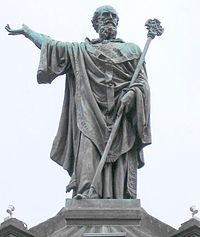
Image result for urban ii
Statue of Urban II at Clermont in France. From Wikipedia
At the heart of the crusade indulgence lies the idea of merit or spiritual reward. The promise of heavenly merit was a powerful incentive to both monarchs and warriors who took up the cross and answered the Church’s call for a holy mission. Understanding the incentives offered to those who took up their sword for the cross is vital to understanding the crusades and their appeal in the Eleventh and Twelfth centuries. The crusade indulgences offered by the medieval Church were the “institutionalization of the idea that fighting for Christ and the Church was meritorious in the sight of God, and thus worthy of a spiritual reward proclaimed by the Church.” (6) The crusades were no ordinary warfare but rather “wars pleasing to God.” (6) Bysted aims to examine the indulgences but also the theology of spiritual reward offered by Catholic theologians.
An attempt to understand the crusade indulgences requires an understanding of the definition of indulgences.
 A modern understanding of an indulgence is the remission before God of the temporal punishment for sin the guilt of which is already forgiven, which a properly disposed member of the faithful obtains from certain and definite conditions with the help of the Church which, as the minister of redemption, dispenses and applies authoritatively the treasury of the satisfactions of Christ and the saints. (10-11)

Indulgences only forgive temporal punishment and do not allow escape from the eternal penalty of Hell and do not remove the guilt of sin. The reception of an indulgence requires confession and contrition. The granting of absolution for sin only comes after genuine confession. Indulgences are remissions of sin before God, and the merit granted derives from the treasure of the merits of Christ and the saints, but the issuance of indulgences is only valid from the authority of the church which has been granted the Keys to the Kingdom by Christ. Uncertainty existed over which party within the church possessed the authority to grant indulgences. It is certain that the Pope had the authorization to issue indulgences and likely bishops under the Pope but the legitimacy of indulgences granted by priests appeared unclear. The relationship between indulgences and penance is a key component of understanding the appeal of indulgences. Indulgences allow a remission of penances but are not sacramental. An indulgence removes temporal punishment but does not impact the eternal punishment of sin. Indulgences are only effective after confession of sin and the reception of absolution.
The difficulty in defining the crusade indulgences is the uncertainty of the nature of indulgences in the twelfth century.
The differences between temporal and eternal punishment, and between remission of guilt and remission of punishment did not appear in theological works before the 1120s and 30s, and the concept of the treasure of merits of Christ did not evolve before the thirteenth century. (13)

The appearance of indulgences arose out of particular needs and for specific purposes such as the crusades for a purpose laid out by the church under the authority of the pope. The understanding of indulgences is best understood by the Latin phrase remissio peccatorum, or the forgiveness of sin, along with a poena et culpa, or pain and guilt. These phrases often cause conflict with Protestant theologians, beginning with Martin Luther, who view indulgences as a crass financial payment for forgiveness. But according to Nikolaus Paulus, indulgences were never issued apart from confession and absolution for sins. Indulgences never appeared apart from true confession and penitence. (14-15) The connection of indulgences with money was an aberrant situation, and the Council of Trent declared that the authority to issue indulgences was granted by Christ to the Church from the beginning, but contemporary scholarship recognizes that indulgences rose in the eleventh century, and the theology of indulgences was still in formulation during the Crusades.
            The origin of indulgences divides both historians and theologians, with one group claiming that indulgences appeared out of the commutations and redemptions of penances, while a second group claims that indulgences developed from the general absolutions for sins. (18) Protestant historian Henry Charles Lea claimed in 1896 that indulgences appeared in the eleventh century and were not a doctrine of the early church. Lea believes that indulgences arose from the commutations of pious works and were an import from the power of the clergy to modify the conditions of penances depending on the genuine repentance of the penitent. Nikolaus Paulus believes that indulgences had a continuity and that the practice was not an aberration from Catholic tradition. While acknowledging the appearance of indulgences in the eleventh century, Paulus stated that indulgences rose from individual commutations and redemptions of penance. Paulus pointed to the remission of penances granted by Alexander II to warriors who fought against the Moors in 1063. (20) Adolf Gottlob proposes that indulgences rose out of the general absolution in privileges granted by popes and bishops. He strongly disagrees with Paulus that indulgences bore any relation to individual redemptions. (21) Gottlob strongly suggests that indulgences bear similarity to the political tools of popes and bishops. Bernard Porschmann stated in 1948 that indulgences were a combination of both absolutions and commutations and were “episcopal grants of mercy in exchange for certain pious works.” (23)  But one serious question impacting the theological nature and historiography of indulgences is the transcendental impact of the practice. The impact of indulgences on the eternal condition of the believer remains ambiguous as the target of the indulgence is to address temporal punishments.
            Historians of the crusades view indulgences as an integral key to understanding the motives of the Crusaders. Along with the importance of vows and the call of the pope, indulgences remain a crucial part in comprehending the deployment and enlistment of soldiers for a holy war. While it is apparent that the crusaders received promises of spiritual rewards for their participation in the crusades, the exact implications of these rewards and how the individual warriors understood the promises still remain debatable. A key to understanding the development and use of indulgences during the crusades is its emergence from the penitential system. (43)
            When surveying Pope Urban’s sermon at Claremont, the problem one encounters is the fact that the sources for Urban’s sermon originated years after the events. This creates a problem regarding the answer to the question of Urban’s intention when offering spiritual rewards for participation in the crusade. The faith that the crusade was a movement of God and the experiences of the crusaders may have predisposed the chronicler’s accounts of Urban’s message to emphasize the spiritual rewards available to the warriors. (47) But the chroniclers greatly impacted how later generations viewed the spiritual nature of the crusades. The letters of Urban II, and the actions of previous popes provide another outlook on the attitudes regarding the benefits Urban and his contemporaries believed the crusades offered for believers. The proposal that warfare offered a spiritual reward appears when Pope Gregory III persuaded the Franks to defend the Papal States against the Lombards and Greeks and later in the ninth century rewards served as an incentive for those recruited to take up arms against Arabs advancing against Italy. In the eleventh century, Alexander offered absolution to Normans combating Muslims in Sicily and Southern Italy. Gregory VII offered absolutions for troops and stressed the idea of servitium sacti Petri, the service of St. Peter as warriors owed Peter their fideles. Previous papal actions reveal a precedent of transcendental promises such as eternal life and the absolution of sins. The letters of Urban II also emphasize the meritorious rewards for crusaders. In a letter, he relays the promises given at Clermont,
You should know, moreover, that if any men among you go there not because they desire earthly profit but only for the salvation of their souls and the liberation of the Church, we acting as much on our own authority as on that of all the bishops in Gaul, through the mercy of almighty God and the prayers of the Catholic Church, relieve them of all penance imposed for their sins, which they have made genuine and full confession, because they have risked their belongs and lives for the love of God and their neighbor. (67-68)

The uncertainty regarding the development of the origins of indulgences warrants an examination of the theological issues of indulgences. Indulgences appeared in the early medieval period as a relief to the burdens imposed by the “tariffed penance.” (75) According to the severity of the sin, the required penance became very severe and could take years of continual penitential activity. The higher the sin, the harsher the penance, and the penalty imposed upon the clergy was more punitive. The addition of commutations and redemptions allowed for more flexibility if the penitent lacked the ability to complete the needed penance. Absolution also granted relief. The church granted absolution for the forgiveness of sins to the seriously ill but also began to be employed in the construction of churches and in warfare against the enemies of the church. (76-77) As indulgences developed in the eleventh and twelfth century, the distinction between absolution and commutation compared to indulgences remains difficult. The question remains, did the indulgences offered to the Crusaders have a transcendental impact? Urban seems to indicate that the reward offered to the crusaders had the same impact as the completion of penance. If Urban declared that the “crusaders did something that equaled their penance and proved their conversion, then their deeds would also have a transcendental effect.” (96)
Medieval illustration of a battle during the Second Crusade
A battle of the Second Crusade (illustration of William of Tyre's Histoire d'Outremer, 1337) From Wikipedia
By the time of the First Crusade, the theology of indulgences was not fully developed, but during the twelfth century, the use of indulgences became more widespread and institutionalized. The fruition of Purgatory as an in-between phase sandwiched between heaven and hell. Purgatory set out the necessity to settle temporal sins and punishments before admittance into heaven. Peter Abelard stressed the necessity of contrition in connection to absolution. He stressed the necessity of appropriate penances for sin and the repentance connected to contrition. If one does perform a penance that falls short of the necessary penance, then future punishment lies in the future. According to Abelard, penance is the medicine which “heals the wounds of the soul.” (107) Abelard rejected indulgences but his theology set the stage for the further development of indulgences. Theologians of the time expressed concern that those receiving indulgences possessed contrition and not take their sin casually. Contrition was a sign of a state of grace and forgiveness in the life of the believer. His eternal punishments were forgiven by God so that only his temporal punishments remained (114-115). Indulgences receive their efficacy from the believer's sorrow over sin and therefore grant relief from temporal sins. The Fourth Lateran Council in 1215 further clarified the use of indulgences. Indulgences issued by bishops received a maximum while plenary indulgences issued by the popes appeared possible. But the Council did not provide further precision of the theology of indulgences but only provided some guidelines. By the thirteenth century the appearance of the treasury of merit incentives to the issuing of indulgences. As the treasury of merits granted by Christ was unlimited, then there was an end to the supply of grace. Thomas Aquinas also laid down the conditions for an effective indulgence, stating that the cause of the indulgence must be worthy of the honor of God and the necessity of the Church. The giver of the indulgence must also possess the authority to issue the indulgence, that is, someone authorized by the pope. The receiver also must be in a state of charity and contrition. Because,
the crusade was a worthy cause, pertaining to the honour of God and the utility of the Church; it was proclaimed by the pope, and if the recipient had truly repented, confessed his sins and taken the vow he had fulfilled his part of the requirements. (145)

Jacques de Vitry speaks of indulgences often in his sermons and points to the reward given to those who take up the cross. Those who are contrite and repentant who die in the service of Christ are “safe from the tortures of hell, in the glory and honour of being crowned in eternal beatitude.” (149) de Vitry expresses the transcendental benefits of the crusade quite clearly. The one who takes a vow to journey on a crusade puts on “the sign of salvation, the cross, which is the key to Paradise and a Jacob’s ladder to Heaven.(151)
            Crusaders received both temporal and spiritual status when he took up the vow to journey on a crusade. He received a promise that his family and property remained under the protection of the church and he received a special spiritual status when he took up the cross. As a sign of his special status, he received a cross to sew upon his clothes. (156-157) The scope of the crusades extended beyond the journey to the Eastern Roman Empire and the Holy Land but also extended to Spain, the pagan Slavs, and against heretics. Those who supported the crusades through financial support also had an opportunity to receive indulgences. The issuance of indulgences to those unable to journey demonstrates that the popes were less restrictive in the use of indulgences. (162) By the Fourth Lateran Council and the bulls issued by Pope Innocent III, indulgences became more institutionalized and standard in their forms. Through the use of the Patrologia Latina Database (PLD), a database of church writings, papal bulls promising remissions of sins appear in one-third of the calls for crusades and holy wars. (195) The popes increasingly used their authority as the successor of Peter to issue indulgences to crusaders. They granted indulgences based upon their authority as the bishop of Rome. (204)
            As the crusaders received merit for their sacrifice, popes and theologians also justified the crusades as a defense of Christ and the justification for meritorious service. The defense of Christ replaced the liberation of the Eastern Church as a validation for the crusades. Looking at the writings of Augustine, theologians used the just war theory as a reason for a just warfare. After the fall of Jerusalem to the forces of Saladin, the reasons for war shifted to an obligation for all Christians. Nis nobis exhorted all to fight and take up arms and if one lacked the ability to fight then one should aid financially. (233)
            The person of Christ provided an example for crusaders as they sought to take up the cross of Christ. The imitation Christi or the imitation of Christ became the exhortation to the crusaders as they identified their suffering with the suffering of Christ. Christ became an example of self-sacrifice and crusaders heard encouragement to give up all in the manner of Christ. As the crusader experiences suffering, he receives merit with his suffering and defends the honor of Christ against the enemies of the Church.
            Bernard of Clairvaux defined the crusade as a jubilee or tempus acceptabile and directed crusade theology away from “self-salvation and semi-Pelagianism by emphasizing God’s mercy as the operating force behind the crusade.” (242) The crusaders received merit because the crusade was a jubilee and a time for penance and special grace.
Bernard of Clairvaux - Gutenburg - 13206.jpg
Bernard of Clairvaux from Wikipedia
From 1095 to 1216, Bernard and other preachers spread the merit of the crusades to audiences throughout Europe. The relation between the crusade and the meritorious reward was clear and preached to Christians through sermons and bulls. Abbot Martin in a sermon clearly states the benefits, “Christ wants help… he summons his soldiers to restore to him his rightful inheritance; and in return for this service, he will reward them generously.” (266)
Indulgences were granted to warriors because the church believed the crusade to be a meritorious act in the eyes of God. It was an act worthy of praise and reward. The transcendental impact of the crusades was evident in the words of preachers and theologians as well as the bulls issued by popes. With the availability of the treasury of merit, Popes granted indulgences to large groups of people and the remissio peccatorum became inclusive of both remission of punishments and of guilt and “was used both for the indulgences and for the sacramental forgiveness of sins. (276-279)

Monday, October 22, 2018

The Goths & the Muslim Conquest of Spain: An Examination of Conquerors and Chronicles of Early Medieval Spain edited by Kenneth Baxter Wolf


The Goths were a Germanic barbarian tribe which appeared in history during the end of the Roman Empire. Gothic history on the Iberian peninsula also shaped medieval Europe. Within Conquerors and Chronicles of Early Medieval Spain edited by Kenneth Baxter Wolf presents the Gothic history of Spain within the medieval sources of Chronicle by John of Biclaro, History of the Kings of the Goths by Isidore, The Chronicle of 754, and The Chronicle of Alfonso III. These sources frame the history of Gothic Spain within the context of the Muslim invasion of Spain. John of Biclaro and Isidore both viewed the Visigoth military conquests and Catholic conversion as signs that the Visigoths were constructing a newChristian empire. The writers who followed faced the failures of the Visigoths to defend their kingdom from Muslim invaders, but John of Biclaro and Isidore set a pattern for the historians who followed them. (Wolf, xvi-xvii)
Islamic expansion into Spain

            The Visigoths settled Spain and ruled during the period before the Muslim invasion. These sources provide insight into how the “Visigothic Kings were transformed from heretical barbarians into the legitimate heirs of Christian imperial rule in Spain.” (Wolf, xvii) John of Biclaro was born in Lusitania and became a Catholic. The structure for his history revealed influence from Sextus Julius Africanus and Eusebius of Cesarea. Much of his history occurs after the reign of Eastern emperor Justinian and John dates his events according to their rule and the years of the Visigoth kings. John greatly admired the Kings of Toledo and presented their rule as restorers of Christian rule. John reveals King Leovigild’s battles as restoring the kingdom “to its former boundaries the Goths, which by that time had been diminished by rebellions of various men.” (60) While southern Spain was a province of Justinian, John ignored the fact that Leovigild’s conquests came at the expense of the emperor in Constantinople. His admiration for Leovigild leads John to avoid details regarding his Arian faith. He does include Leovigild’s invitation to Arian bishops to discuss the prospect of allowing Arian converts from Catholicism to convert without a second baptism. This practice allowed converts inclined toward the Arian doctrine out of self-interest rather than a change of heart.” (68) John’s wording appears to sound more critical of the Catholics who convert to Arianism than the King, since the King allowed an easier route for conversion. (7)
King Leviogild statue in Madrid


            The distinguishing mark of Reccared’s succession to the throne was his conversion to Catholic Christianity. John describes his reign as one of piety and devotion, with the construction of many churches and monasteries. (73) His account of Reccared differs from his earlier reports because John offers commentary on the rule of the King as a Christian King and inheritor of Christian Rome. Victory over the Franks and his conversion to Catholicism appear as the actions of a “Christian emperor.” (10) While Nicea declared Arianism heresy, John declares that Arianism prospered until it had been “cut at its very roots so that it will not sprout up again, a Catholic peace having been bestowed upon churches everywhere.” (75) John infused great symbolism into the Kings of Toledo to demonstrate that they were Christian rulers blessed by God.
            Isidore of Seville was the archbishop of Seville and chronicled his account after the histories of Eusebius. He wrote his History of the Kings of the Goths after he finished his Chronicle. Isidore presents Spain as the most blessed of provinces and the “pride and the ornament of the world.” (79) For such a blessed land, Isidore connects the ruling Goths to a rich and ancient history. He transforms the Goths from fierce barbarians into powerful kings. (15) Referring to Ambrose, Isidore takes Ambrose’s attempt to connect Goths to Gog as a scourge as seen in the Old Testament book of Ezekial. Isidore instead substitutes the word Getae and makes a genealogical connection to the line of Japheth in an attempt to provide the Goths with a biblical heritage. (15, 107)
            Isidore stressed the military prowess of the Goths and claimed that when the “Ethiopians, Indians, Persians, Medes, Greeks, Scythians, and the rest of the eastern peoples were summoned to fight against Julius, the Goths resisted him more powerfully than the rest.” (81) Blame for the Gothic attachment to Arianism goes toward Emperor Valens, who tempted the Goths with heresy by sending Arian missionaries.
Like John of Biclaro, Isidore saw the reign of Reccard as the arrival of a righteous Christian King and placed the symbols of the Christian emperor upon Reccard. “The victories that his Goth’s won were to be, like those enjoyed by the early Romans,  a simple function of their valour and strength.” (22) The succession of Sisebut to the throne also marks a period of piety and praise from Isidore. The attempt by Sisebut to compel the Jews to convert to Christianity happened because of Sisebut’s zeal when he should have called the Jews to “faith through reason.” (105) Isidore attempts to describe ideal Christian rulers characterized by faith and prudence, inheritors of Christian Rome.
The Chronicle of 754 occurs after the events described by Isidore who presented the rule Sisebut and Suinthila as a Christian rule destined for a long blessed rule. The Chronicler faces a different situation than Isidore for he must understand how Christian Kingdoms fell to Muslim rule. He begins with the reign of Emperor Heraclius who the writer portrayed as a ruler chosen by God but given over to the praise of the people after the military victory against the Persians. Heraclius receives a dream that “he would be ravaged mercilessly by rats from the desert,” as well as many “astrological signs.” (113) Many histories point to this sin as the root cause of the fate which befell the Gothic rulers and the  Arabic military victories fulfilled the vision of Heraclius. The Chronicler avoided interpreting the Muslim invasion as a scourge but instead dealt with each Muslim ruler individually and tends to avoid religiously charged language. Descriptions of the Caliphs bore a remarkable similarity to descriptions of the Visigothic or Frankish rulers. The reality of the conquest of Christian Spain by non-Christian Muslim rulers appears to limit the ability of the Chronicler, therefore he avoided interpretation.
The Chronicle of AlfonsoIII plows within the same territory as the Chronicle of 754 but unlike 754, The Chronicle of Alfonso III does not take a religious neutral perspective when discussing Muslims but rather views the Muslim invaders as a plague and punishment sent by God to a sinful people. The Chronicler begins his account with accession of King Wamba and covers nothing later than the death of Ordono I in 866. His account appears as a continuation of  Historyof the Kings of the Goths by Isidore and seeks to make a connection between the Gothic and Asturian kingdoms. The Austurian throne in Oviedo continues the Gothic rule on the Iberian peninsula as the legitimate rulers of Spain and the remnant of Christian imperial rule. Raids led by Alfonso represented the remnant of God carrying the fight against the Muslim scourge with the eventual reclaimation of their “promised land.” (45)  The problems for the Toledo monarchy began with an attempt on the life of Wamba through poison by Count Ervig. The loss of his senses forced Wamba to abdicate the throne and Ervig rose to the throne. Ervig died without an heir and his son in law Egica became king and married the daughter of Ervig Cixilo. Wamba denounced Cixilo due to his bitterness of losing the throne. Cixilo gave birth to Witiza, who assumed the throne upon the death of his father. But Witiza “was a reprobate and was disgraceful in his habits. He dissolved the councils. He sealed the canons. He took many wives and concubies.” (164) The sin of the King as the representative head of the people caused the favor of the Lord to fall from the Kingdom. Because, “the kings and priests forsook the Lord, all the armies of Spain Perished.” (164)
The largest section of the Chronicle recounts the story of Pelayo’s resistance at Covadonga. Pelayo appaears as the hope for the restoration of the Kingdom to the Goths. His dialogue with Oppa the bishop of Toledo contrasts the righteous Pelayo with the collaborator Oppa. Pelayo places his trust in Christ as the one who will restore the kingdom and rid the land of the invaders. He reminds the bishop that the church is like a mustard seed and says, “Christ is our hope that through this little mountain, which you see, the well-being of Spain and the army of the Gothic people will be restored.” (168) The Chronicler sees the future of the Goths continuing through the promise of God to restore the remnant.
Pelayo, victor at Covadonga and first King of Asturias. From Wikipedia

 
Conquerors and Chroniclers of Early Medieval Spain. Translated by Kenneth Baxter Wolf. Liverpool: Liverpool University Press, 1990.


Friday, October 12, 2018

The Goths: The Gothic History of Jordanes, An Examination


The Goths were a Germanic barbarian tribe which appeared in history during the end of the Roman Empire. The Goths were instrumental in turning back the invasion of Western Europe by the Huns. One of the sources for Gothic history is the Getica written by the Gothic writer Jordanes.

            Jordanes was a Goth who held the position of military secretary likely wrote his history in Constantinople in 551. He was a convert to Nicene Christianity from Arianism and was possibly a bishop since there was a Bishop Jordanes in Constantinople during the same time. Jordanes based much of his history upon the work of Cassiodorus Senator, who was a secretary to Theodoric the Great and his successor Athalaric. Like Cassiodorus, Jordanes wished to elevate the Goths as partners with Rome to bring “peace and prosperity” to both people. (Mierow, 16) Jordanes’ use of Latin reveals a writer unskilled in the language but he is very open about the fact that he was “unlearned” before his conversion. But Jordanes remains important as the earliest surviving work of a Gothic historian.
            Jordanes begins his history by detecting the origin of the Goths within the geography of Europe, Asia, and Africa. He identifies the island of Scandza as the birthplace of the Goths under their King Berig. An examination of the geography Jordanes provides clearly identifies Scandza as Scandinavia and much of his early history contains mythical elements. Berig led the Goths from Scandza in three ships across the sea and eventually into the region of Scythia in central Eurasia, north of present-day Iran. Upon leaving Scandza, King Berig encounter the Vandals and “subdued” the barbarian tribe. (57) Jordanes presents the Goths within the midst of ancient and mythical history to portray the Goths as an important tribal group alongside the Roman Empire. He has the Goth’s present during the sacking of Troy and in an alliance with Phillip of Macedon during his conquest of Greece. By placing the Goths alongside the Egyptians, Amazons, and Persians, Jordanes gives the Goths a rich heritage comparable to the Greeks and Romans.
            The Getica becomes more historical as the Goths encounter the Romans in the Third Century A.D. The Goths fought alongside Emperor Maximian against the Parthians and alongside Constantine against Licinius. Jordanes becomes a valuable source through his historical accounts of the Huns, but he mixes his account of the origin Huns with the mythology of the Goths. King Filimer, the fifth king after the exodus from Scandza discovers witches among the Goths in Scythia. He expels the witches, who begin as a “
savage race, which dwelt at first in the swamps, a stunted, foul and puny tribe, scarcely human and having no language save one which bore but slight resemblance to human speech. Such was the descent of the Huns who came to the country of the Goths. (85)

            Jordanes marks the division of the Goths between the Ostrogoths who settled in the East and the Visigoths who settled in the West. The Visigoths become key players during the reign of Valens. Valens, an Arian, meets an untimely end at the Battle of Adrianople (Hadrianople) when he is wounded and after seeking shelter within a hut he burns to death after the Goths set fire to the structures. Jordanes clearly makes a connection between Valens’ heresy and his dishonorable death. Arian treachery appears when Valens’ lieutenant, Lupicinus invites Gothic chieftain Fritigern to a feast with the intention to kill him when Fritigern lays down his guard. But, Fritigern turns the table on the Romans when he hears the cries of his men and kills the Romans generals. While Jordanes wishes to establish a connection between the Goths and the Romans, Romans tied to Arian heresy meet their deserved judgment.
Battle of Adrianople Taken from about-history.com

            The relationship between the Romans and the Goths receives emphasis when King Alaric and the Visigoths send an embassy to Emperor Honorius and promise to settle if allowed to settle in Italy peacefully, but fearing the Visigoths Honorius promises homes in Gaul and Spain. After leaving the Goths met an army led by the patrician Stilicho who attacked the Goths. Throwing back the attack the Goths under Alaric went on to sack Rome, but they “did not set the city on fire, as wild peoples usually do, nor did they permit serious damage to be done to the holy places.” (94) When Athavulf became king, he sacked and stripped Rome “bare like locusts” and took the sister of Emperor Honorius, Placidia as his wife. Athavulf departed Rome with her wealth, but leaving Honorius Augustus, “pleased at heart because he was now a sort of kinsman of his.” (96)
 Painting of the meeting of Pope Leo and Attila created in 1514 by Raphael taken from Stanford History Education Group

            By the Fifth Century, Attila ruled over the Huns and all the tribes of Scythia. Attila was a fierce warrior, who was a “lover of war.” (102) Gaiseric, the king of the Vandals enticed Attila to attack the Visigoths since he feared Theodorid, kingof the Visigoths. The Visigoths allied themselves with the Romans to defend themselves against Attila and his Huns. At The Battle of the Catalaunian Plains, the Romans under General Flavius Aetius combined their forces with the Visigoths under King Theodoric I. Jordanes records the inspirational speech of Attila and the battle resulted in the death of Theodoric when his horse threw him and then trampled by his own men. The Hun advance ended with the battle but the Huns continued to loot and pillage Gaul. Eventually the Huns arrived outside Rome but Attila and his army left after a visit from Pope Leo I persuaded him to depart peacefully.
A painting of Attila riding a pale horse, by French Romantic artist Eugène Delacroix (1798–1863) from Wikipedia

            Attila returned to his home country but threatened violence again when tributes promised by Theodosius failed to arrive. He promised more violence and warned Marcian the Emperor of the East of devastation. Attila turned toward the Visigoths but then moved his army in a different direction. Visigoth king Thorsimud sensed Attila’s trick and stopped the advance of Attila’s forces. The Visigoths routed Attila, who fled to his home territories. Jordanes reports Attila’s death as a disgraceful end. After a round of drunkenness, his attendants found Attila laying on the ground without any wounds but dead from an effusion of blood pouring from his mouth. (123)
Jordanes presents the history of the Goths in an effort to present the formerly barbarian Goths as admirable and worthy partners with the Romans. They excel in battle and as they remain faithful to Nicene Christianity the promises of God for blessings are assured. He concludes his work with the defeat of the Goths by the emperor Justinian through his consul Belisarius. But the Goths were a praiseworthy foe as illustrated by the reception of King Vitiges into Constantinople and awarded the title of Patrician.

Tuesday, September 25, 2018

The Great Caliphs


Early Islamic history often receives accusations of jihads and barbarism intent on conquest and intolerance. This characterization and stereotyping received new impetus with the recent history of terrorism spreading from radical forms of Islam. Even sympathetic scholars tend to paint a stark picture between the Islamic caliphs and Western culture. Amira K. Bennison presents a much broader picture of the Abbasid caliphates as a center of learning, science, and culture. While the caliphate appears intolerant in comparison to modern standards, the Abbasids typically allowed Jews, Christians, and Zoroastrians to worship and participate within the confines of their rule. Within the pages of TheGreat Caliphs: The Golden Age of the Abbasid Empire, Bennison discusses the false dichotomy which stresses a stark difference between early Islam and the West. She rejects the oriental label placed upon Islam and instead stresses the connections early Muslims had with Graeco-Roman, Byzantine, and Sasanian heritages while developing their own “separate and sparkling Islamic character. (Bennison, 3) Greek science and philosophy entered medieval Europe through Arabic sources but the Arabs were not merely neutral messengers but they fully engaged with resources “translated from Greek, Persian, and Sanskrit into Arabic, and that they added a great deal of new material to the information they received.” (3) Unlike the stereotype perpetuated today, the Abbasid Caliphs presided over a cosmopolitan society that shared traditions from many great civilizations.  
The Umayyad Caliphate from IBDP History

The Abbasid Empire rose in the 750s from the decline of the Umayyad caliphate and originated about 120 years after the death of the Prophet Muhammad in 632. The Caliph was the political and spiritual head of the Muslim community. While early Muslims were not specific in their description of the role of the Caliph, the significance of his leadership was evident as the successor to the Prophet. The first four caliphs chosen by consensus from early Muslims received the title the Rightly GuidedCaliphs from the Sunni majority. These men assumed the role of imam and commander of the faithful, filling a spiritual, political, and military role. Mu’awiya was the first caliph of the younger generation and moved the seat of power from Medina to Damascus. Damascus allowed the empire to continue their conquests and direct their empire from a central location. But the adoption of a hereditary succession for caliphs prepared the way for a Abbasid rise in 750. After Yazid became caliph after his father Mu’awiya died, Husayan the head of the Alid clan challenged Yazid. The slaughter of many Alid, even the grandson of the Prophet caused a rift between the Umayyads and the Shias.
The Abbasids rose to power, promising a just Islamic rule and a caliphate closer in relationship to Muhammad. The Abbasid caliphate lasted for over five hundred years and “presided over the maturation of the early Islamic empire from a state supported by the fruits of conquest- tribute, booty, and slaves- to one supported by the taxation of land, produce, and people.” (28)  The five hundred year rule of the Abbasids can be divided into three periods with the early Abbasid caliphate lasting from the mid-eighth to the early ninth centuries. The middle caliphate saw the creation of a Turkish army and a move to Samarra for fifty years. During the mid-ninth to the mid-tenth the caliphs found themselves dominated by Shi’i warlords and Shi’i Fatimids with the Fatimids creating a rival caliphate. During the third phase, the caliphs were at the mercy of the Saljuq Turks who ruled from Baghdad. The Saljuq Sultanate produced a situation in which many sultanates existed simultaneously creating a more pluralistic understanding of Muslim political life. (46) The entrance of the European Crusaders saw the demise of the Abbasid caliphate. While the crusaders made temporary inroads into caliphate territory, the Mongol invaders hastened the end of the Abbasid caliphate. The Europeans were a sideshow while the Mongols succeeded in capturing Baghdad, killing the caliph, and transforming the political geography of the Middle East. (53)
The Abbasid Caliphate 

The Abbasid caliphs created urban centers that teemed with culture, fantastic architecture, and art. The urban life of the caliphs demonstrated both continuity and change from the Roman Mediterranean and Middle Eastern society. The reality contrasted greatly with the orientalist and imperialistic attitudes of Arab cities as dirty and cramped. Early Arab Muslims brought “deep-rooted urban traditions” which they imported to newly conquered territories. (57) Early towns featured a vibrant market life and Arab’s negotiated with Christians over space. The construction of Baghdad as the center of the Abbasid caliphate brought Persian influence in the design and layout and became the center of a vast Islamic empire stretching from India to Tunisia. The architectural influence of the caliph spread to Abbasid governors and the Umayyads in Spain as others styled their cities after Baghdad. (74) The Abbasids saw their empire as territory connected by roads and highways, and they made use of engineering and technology of the time to deal with their water and sanitation issues. Mosques, schools, and shopping districts made life pleasant and while poverty existed, “the Abbasid age offered one way in which humans could live in a sophisticated and pleasant urban life.” (93)
From Wikipedia

Abbasid life while dominated by Islam still contained an aura of cosmopolitan variety with Christians, Jews, and Zoroastrians living with a degree of tolerance. Instead of the conversion by sword these religious groups enjoyed the freedom to worship as long as they acknowledged Abbasid rule. In the beginning of Abbasid rule, Muslims were a minority but converts increased as conversion brought new opportunities. As Christians and Jews became minorities they still enjoyed relative freedom as Muslims considered both Jews and Christians as people of the Book. But the courts of the caliphs provided opportunities for many as the he depended upon ministers and officials to administer his empire. Scholars, poets, and secretaries found important roles within the administration. Religious minorities found inclusion as the caliph used Zoroastrian astrologers and astronomers, as well as Christian physicians.
Trade was a vital factor of the empire as seen from the beginning of Islam. Mecca was the center of trade on the Arabian Peninsula before the birth of Islam as pagans journeyed to Mecca for religious purposes. Islam was “not the product of an isolated desert outpost, but of a region with a long commercial history in addition to well-established cultural, political, and military connections with the Fertile Crescent and the lands beyond.” (138) Trade played a role with Muhammad and the relationship with his first wife Khadija and the hadith contains numerous sayings placing value upon trade and commerce. (139) This value placed upon commerce reflected on the massive amount of trade within the Abbasid Empire as well as areas outside their regions. Traders dealt in dried fruit, wine, cloth, weapons, and slaves as Muslims dominated the Mediterranean trading routes.  

At the center of the Abbasid Empire, the city of Baghdad observed a renaissance as Math, Arabic grammar, rhetoric, and poetry offered an intellectual picture of a society with advanced learning. Stress on Arabic created an Arabic self-identity and an intellectual culture centered on Arabic. Over time Christians began writing books in Arabic so their ideas gained a wider audience. While the Quran was the primary textbook other subjects such as sports and music found opportunities under private tutors. (163) Abbasid scholarship began to steer away from the Syrian thought influenced by the Byzantines and produced a more “universal Muslim sense of identity.” (167) Muslim work at translation and transmission of ancient Greek and Persian documents not only enriched Muslim scholarship but made positive contributions to human civilization. Islamic scholars sought out Greek, Persian, and Indian learning and translated the works into Arabic. But Muslims interacted with the knowledge and made their own contributions. Baghdad saw the appearance of intellectual majlis or salons, where scholars, thinkers, and poets gathered for stimulating discussion and debate. Muslims, Christians, and Jews gathered together freely to share their opinions. (181)
Of special interest is the religious role of the Caliph. From the beginning, the caliph possessed a religious function within the community. With the passing of time, religious scholars saw Quranic interpretation as their primary function and believed that the role of the caliph was secondary to their position. Caliph Al-Ma’mun had a deep dislike for hadith scholars and forcibly expressed his opinion regarding the nature of the Quran. Most religious scholars viewed the Quran as uncreated although the caliph believed that this doctrine encroached upon the transcendence of God. Near the end of his rule Al-Ma’mun formed an inquiry (mihna) and insisted that scholars teach the doctrine of the createdness of the Quran. While the inquiry was tame compared to similar European religious courts, the religious scholars eventually won the argument regarding the nature of the Quran. (34-35)
While the European Renaissance remains a European event, the contribution of Islamic scholars to an understanding of the classical world remains an integral part of study. Europeans experienced a revival of classical culture in the Renaissance but that revival depended upon the Arabic intellectuals who preserved and interacted with the classical tradition. The Abbasid intellectual tradition contributed mightily to our present understanding of the classics and art. This is an understanding which builds bridges and contributes to positive interactions in the future.


Thursday, July 26, 2018

Imperialism in Asia: A look at 3 Regions- India, China, & Indochina


Clive after The Battle of Plassey


By the late Eighteenth Century, Colonialism began to take a different shape after the American Revolution with the British domination of India. The British imperial movement in Asia began with a desire for trade. The British foothold in India became solidified after the Battle of Plassey followed by the gradual British control of the entire Indian subcontinent. Trade also led to European domination over the isolationist Kingdom of China. While China never experienced the level of European control seen in India, Europeans still impacted the Chinese kingdom through enforced trade and missionary influence. The changes within China arrived in spite of deep Chinese distrust of outsiders and policies of isolation. The imperialism which first reached began a process of transformation felt throughout the entire continent of Asia. The consequences of European domination still vibrate throughout the countries and cultures of Asia leaving no group unaffected by past Western power. The aim of this paper is an exploration of the impact of Western imperialism and influence within Asia through an examination of India, China, and Southeast Asia. A study of these three regions reveals that foreign power and intervention led to many of the most violent and traumatic events of their history.
Coat of Arms for the English East India Company from culturalindia.net

           
The beginnings of British imperialism of India arose from the European desire for Asian spices and silks. Queen Elizabeth I granted the East India Company a charter, and the English rapidly passed the Portuguese as the dominant European power on the subcontinent. The British motive for imperialism contained at its heart a desire for trade and economic power. The Company began as a purely mercantile power but gradually gained political power as the Mughal Empire weakened. During the early years of their rule, the Company strived to avoid interference with Indian culture and religion even going as far to ban missionaries from their territories because they wanted nothing to hinder trade. But the policy of cultural non-interference faded as the Company increased its authority in an attempt to protect trade interests. Military and territorial expansion became justified as necessary for safeguarding trade and commercial interest. As the British expanded they placed pressure on local rulers for concessions and control. In 1801 the Company pressured the Nawab of Oudh to cede much of his territory. In 1803 the British occupied Delhi and gave the great-grandson of the Mughal emperor Aurangzeb a puppet throne. Shah Alam received the title the King of Delhi and an allowance but only ruled within the walls of the Delhi Red Fort. (David, The Indian Mutiny, 5)
            As the East India Company expanded, one of their primary tools were the Sepoys. The Sepoys were native Hindus and Muslims recruited by the Company to serve as soldiers in their military. Cultural and religious conflict boiled underneath as the British imposed their own societal expectations upon the Sepoys. Indian concerns such as caste and overseas travel received little attention in the view of the sepoys. Sepoy grievances culminated in the controversy over the rifle cartridges which required animal grease for the smooth loading. The use of cow and pig fat caused considerable consternation among both Muslim and Hindu troops and led to the bloody Sepoy Rebellion in 1857. While the dispute over the rifle cartridges was a primary concern for the Sepoys, their mutiny was the culmination of years of cultural clash and dissatisfaction with British rule.
Two sepoy officers; a private sepoy, 1820s from Wikipedia

            Trade and economic concerns also drove imperial ambitions in China. The British demand for tea led to an unbalanced trade arrangement with the Chinese who gladly traded tea for silver but had no desire for British products. China regarded foreigners as outsiders and wanted nothing to do with people they regarded as barbarians. This attitude of Chinese superiority appears in the letter the emperor sent to the King of England when he said,
Strange and costly objects do not interest me. As your ambassador can see for himself, we possess all things. I set no value on strange objects and have not use for your country’s manufactures.” (Hanes and Sanello, The Opium Wars, 19.) 

The British answer to the trade imbalance was the importation of opium from India into China. The Chinese addiction for opium ravaged China, and the government attempted to fight back by barring opium importation and destroying stocks of opium. The British responded by using their navy and military to inflict a humiliating defeat upon the Chinese. The Treaty of Nanking placed the Chinese into an inferior relationship with the European powers by granting the British and later other Westerners extraterritoriality. British citizens were no longer subject to Chinese laws and further, the treaty forced China to open five ports for trade. While the emperor remained on the throne, China ceded Hong Kong to the British. Chinese humiliation over surrendering sovereignty over to the British led to a second Opium War which also included the French. (Hanes and Sanello, 175) Another defeat led to the Chinese surrendering more ports to trade and continued foreign influence within the borders of China as Westerners and missionaries traveled freely throughout the interior of the country.

The East India Company iron steam ship Nemesis, commanded by Lieutenant W. H. Hall, with boats from the Sulphur, Calliope, Larne and Starling, destroying the Chinese war junks in Anson's Bay, on 7 January 1841 from Wikipedia


Trade and missionary activity led to an influx of new ideas and Western religious philosophies into all regions of China. Foreign traders, who previously crowded around Canton opened at the five ports and set up trade and residency. (Spence, God’s Chinese Son, 62) Missionaries sought converts and printed Bibles and tracts in local languages. The opening of China for trade and commerce also brought foreign missionaries. The Treaty of Nanking guaranteed the rights of Westerners to spread Christianity and encouraged these outsiders to build churches and win converts. Some missionaries acted in a free-lance method, acting independently with little or no supervision. It was in this atmosphere Hong Xiuquan encountered Protestant missionary Edwin Stevens and received a Christian tract titled, “Good Words for Exhorting the Age.” Years later through a reading of the booklet and visions Hong becomes convinced that he is the younger brother of Jesus with the mission to free China from Manchu rulers of China which he identifies with the Devil. Undertaking preaching journeys, Hong finds a receptive audience among the ethnic Hakka and other peasant groups. Peasants not only respond to his spiritual message but find hope in the promise of solidarity and protection from hostile forces. (Spence, 88)With followers, Hong assembles his Taiping Heavenly Army to “reach the people and destroy the demons, so that all may live together in perpetual joy, until they are raised to Heaven to greet their Father.” (Spence, 172) The Heavenly Army attacked the Xing troops with ferocity and zealotry that matched their faith in the message of Hong Xiuquan.
Hong Xiuquan from Wikipedia

            Unlike the Opium Wars, there is no direct connection between the death and destruction of the Taiping Rebellion and the economic ambitions of Westerners. The Taiping reacted toward the corruption and indifference of the Manchus as well as the increased poverty among the peasants. Ethnic tensions also contributed since racial tensions were often the center of Taiping complaints with their declarations tied to the Manchu’sancestry and pretentions. (Spence, 161) While tensions between the Chinese and the Manchu lay close to the causes of the Rebellion, the flood of foreigners into China after the First Opium War contributed to the problems within China. The increasing social issues associated with the flood of opium supplied by Westerners increasingly weakened the foundations of Chinese society causing instability throughout China.
            While foreign influence was a peripheral cause for the Taiping Rebellion, resentment against Western presence was a primary reason for the Boxer Rebellion. The Boxers were an obscure peasant movement whose central creed was “anti-Christian, anti-missionary, and anti-foreign.” (Preston, The Boxer Rebellion, 22) Chinese economic and social conditions spread the Boxer philosophy throughout the Chinese peasant class. Devastating floods, droughts, and locusts’ plagues caused misery for the poor of northern China thereby making them receptive to the Boxer message. Foreign goods flooding China put artisans out of work while steamboats made the jobs of thousands of bargemen redundant. (Preston, 24) The anger of the peasants focused on all things they perceived as foreign. Christian missionaries, Chinese Christians, and foreign interference received the blame for offending China’s traditional gods, causing the gods to punish the land and the people. (Preston, 24) Western government attempts to protect their missionaries only added to the accusation that missionaries were in an alliance with their nations to control China. The murder of two German Catholic missionaries by an armed band only furthered the paranoia when the Kaiser’s government demanded concessions and received control of the Kiaochow Bay as a naval base. German demands that the Chinese government finance the construction of churches and cathedrals only affirmed Boxer accusations against the foreigners and Chinese Christians. All of these frustrations caused the Boxer movement to seep through northern China as a “heartfelt response to desperate and worsening conditions in northern China and an increasing sense of impotence.” (Preston, 24)
Boxer Rebellion from History.com

            Both the Taiping Kingdom and the Boxer movement rose to power because of the frustration of a peasantry that felt powerless before foreign greed and an inflexible monarchy. Both movements used spirituality as a tool to empower the poor in their quest to lash out at the forces which caused their pain and both groups saw themselves as holy warriors striking out against the devils causing Chin’s decline. The Taiping followed Hong Xiuquan, who constructed a syncretistic form of Christianity with Eastern beliefs. Their devotion and zealotry against the Qing rulers mirror the ferocity the Boxers exhibited toward all things foreign. Both movements viewed their opponents as evil, and the cause of China’s decline and misfortune. The Taiping and the Boxers rose as revolutionary movements due to the greed of Western imperialism and the intrusion of Christian missionaries. While some missionaries approached Chinese culture with sensitivity, many Western evangelists became instruments who disturbed the social fabric of Chinese life. The Taiping adopted Christian exclusivity and attacked Chinese religious symbols as the representatives of a demonic Qing social structure, while the Boxers viewed Christianity as an alien element which upset the balance of life in China. Chinese Christians became a special target of Boxer anger, as many Chinese viewed these Christians as traitors to traditional Chinese principles. Chinese Christians refused involvement in the cultural and religious customs of village life thereby causing disunion within the community. Practices such as ancestor worship, long common among the Chinese for centuries became branded as a form of idolatry and rejected by Chinese Christians. For many, the rejection of long-held customs was a rejection of Chinese culture and identity. Within the mind of the Boxers, the Chinese Christians ceased being Chinese. (Preston 26)
            The fierceness of the Boxers against the presence of foreigners and Christianity in China bears a remarkable similarity to the actions of the sepoys during the Indian Rebellion of 1857. While Christian proselytizing was not a complaint of the sepoys before the rebellion, the native soldiers attacked with an aggressiveness similar to the Boxers against all things British and Christian. (David, 73) Many Indians suspected that missionaries were the tools of the East India Company with the goal of remaking India in a Western image. Government and Company actions only reinforced the suspicion. In 1813 the East India Company agreed to spend ten thousand pounds on Indian education in an agreement to renew the Company’s charter. The debate centered on whether the education was English or classical Indian. The debate ended when it was agreed that an English-educated Indian middle class was useful as a tool for governance. These educated Indians in the minds of the British were, “interpreters between us and the millions we govern- a class of persons Indian in colour and blood, but English in tastes, in opinions, in morals, and in intellect. (David, 73)  These changes while not causing fundamental changes in Indian village life, accumulated with imperial practices to cause great distrust among many Indians and the sepoys. Like the Boxers, the sepoys lashed out with violence at the scapegoats they perceived as the cause of their problems and both violent incidents trace the problem of an intrusive and grasping Western imperialists. The rapid spread of revolutionary ideas and rebellion in all of these actions demonstrate the power of an aggrieved people. The fact that many Indians within fundamentalist Hindu groups still teach that India is the victim of a Western conspiracy bent on changing it into a Christian image reveals the impact of Western imperialism in the East.
            The deadly violence of partition exposes the deep divisions existing within Indian society before independence. Much of this division existed during the Mughal period but grew during British rule as the British cultivated religious and sectarian differences in an attempt to make their rule essential. Playing each group off of each other made the British the arbiters of India but led to the tragedy of Partition. The British always maintained their rule with the cooperation of Indians. The Mutiny of 1857 came close to ending British rule in India and ended with a British victory because many Indians remained loyal to their British overseers. The Indian Army remained loyal to their British commanders through both world wars and after partition both the Indian and Pakistani armies retained their British commanders soon after independence. Religious divisions were one aspect that allowed the British to retain a hold on India. The distrust nurtured by the British exploded as serious talks of British withdrawal began. The ethnic and religious hatred boiled underneath and partition brought death and brutality, assigning partition among the great tragedies of the Twentieth Century.
            Due to their long imperialistic hold upon India, many British politicians believed they possessed a deep understanding of India but the reality was that a great chasm existed between the mother country and the colonials. Winston Churchill fought against Indian independence and doubted the ability of Indians to be self-governing. His career began in the Northwest Frontier combating tribal groups. He believed himself an expert on India, but his attitudes remained frozen since his time in the Northwest frontier. (Hajari, Midnight’s Furies, 38) During the height of the British Empire, India was the Jewel in the British Empire, but after World War II the British economy was bankrupt and India was no longer able to finance the empire. (Hajari, 7) The divisions which aided Britain in maintaining a hold on the subcontinent tore at the fabric of the country. 
Winston Churchill as a 19 year old officer of the 4th Hussars: Malakand Rising, 26th July to 22nd August 1897 on the North-West Frontier of India from Britishbattles.com

            Similar to the period before the Sepoy Rebellion, the British overestimated their understanding of India. During Company rule contact between officers and Indian recruits remained at a minimum with British officers remaining isolated from the concerns of their men. Likewise, many British officials failed to understand the distrust which they helped to foster. The violence and ferocity seen in the thousands killed in the Calcutta killings and later in the Punjab caught many British officials by surprise.
Caption from LIFE. "Carrion birds feast on victims of bloody religious riot in India." (Calcutta, 1946)

Margaret Bourke-White—The LIFE Picture Collection/Getty Image from Time.com


The inability to discern the consequences of past actions is similar to past movements in other countries. Missionaries within the heart of China saw the threat of the Boxers much earlier than the diplomats, who were slow to make preparations for an attack. Mere weeks before the first attack British diplomat Sir Claude MacDonald sent a note of assurance to Vice-Admiral Seymour describing the “wholesome calm” in Peking. (Preston, 66) The same attitude of confidence caught the British by surprise as angry sepoys struck back at their former officers.
French and American involvement in Vietnam also revealed an ignorance and inability to understand the desires and determination of Vietnamese nationalists for self-determination. Ho Chi Minh drifted to the Communist Party partly due to the failure of French socialists to declare the right of self-determination for colonial people. He mocked those who opposed Lenin with the question, “If you do not condemn colonialism, if you do not side with the colonial people, what kind of revolution are you making?” (Sheehan, A Bright Shining Lie, 157) Both the French and Americans approached the North Vietnamese and the Viet Cong with a paternalistic and imperialistic attitude which underestimated their determination. John Paul Vann recognized the fortitude of the Viet Cong at the Battle of Ap Bac where a small group of Viet Cong guerrillas decisively held off a larger and heavily equipped force of South Vietnamese forces supported by American advisors. American refusal to identify the ability of their enemies involved the American military in a quagmire. The American policy of attrition required that the U.S. increase their involvement from one as advisors then to active participants with the need for greater military immersion in the conflict. Vann always believed that success was possible in Vietnam through a pacification and strategic use of military force but his inability to trust South Vietnamese leadership caused him to advocate for an imperialistic relationship. While Americans viewed themselves as anti-imperialistic, American actions in Southeast Asia bore striking similarity to imperial powers both in Vietnam and in their interference within Cambodia.
Battle of Ap Bac from alchetron.com

Like the British, the French colonial policy in Indochina involved a division of the population against itself to maintain their control over their colony and their presence in Indochina served their economic interests.  In Vietnam, the French used the Vietnamese mandarin class as proxies. The service of the mandarin class under the French caused their close identification with the colonial rulers. The labor of peasants on rubber plantations was highly abusive and exploitative and the mandarins who assisted the French eventually received the label of collaborator. The minority of mandarins who resisted French rule faced imprisonment and oppression but later redeemed their honor in their leadership against French imperialism. The leadership of the Vietnamese Communist Party derived largely from the mandarin class who rejected French colonialism. (Sheehan, 156)
The French overwhelmed a stagnant Vietnam in the Nineteenth Century with superior technology and organization. (Shehann, 162) French colonial practices disrupted and changed the social life of Southeast Asia. The quest for the riches found in the rubber plantations transformed Vietnam at all levels. French opposition to nationalist forces decimated non-Communists alternatives in the 1930s when they sent many nationalists leaders to the guillotine. The work of the French political police in eliminating the Vietnamese political party, the Kuomintang left no non-Communist nationalist alternative after World War II. Only the Communists succeeded in rebuilding their party to oppose colonial rule. (Sheehan, 171)
The allure of imperialism caused many colonial powers to spend more of their resources in eliminating nationalist movements than preparing their colonial subjects for self-rule. The existence today of a democratic India demonstrates that Indian participation in the colonial administration and the existence of a British educated Indian leaders aided India in a difficult transition to independence. But the horrors of partition and the continued conflict between India and Pakistan reveal that the British had no plans for an independent India after World War II. The French also maintained their determination to hold fast to their colonial possessions. They placed great prestige upon their identity as a colonial empire. But the French defeat by the Germans and the Vichy genuflection to the Japanese seriously damaged the French in the eyes of those in Southeast Asia. French failures were even greater in Cambodia. The lack of an educated middle class left the Cambodians vulnerable to rival forces and revolutionary groups within the country. (Ngor, Survival in the Killing Fields, 421-422) While the Cambodian monarch, Sihanouk successfully achieved Cambodian independence while the French struggled with Vietnam, the country was ill-prepared for self-determination. Attempting to retain neutrality during the height of American involvement in Vietnam, Cambodia fell victim to the powers and ideologies competing for ascendancy in Southeast Asia. A coup in 1970 led by the Prime Minister Lon Nol led to divisions within Cambodia as Lon Nol sought an alliance with the United States. (Ngor, 44-45) But the failure of Lon Nol and his alliance with America allowed the Chinese backed Khmer Rouge to gain control and begin a systematic slaughter of the Cambodian people.  The revolutionaries desired a reconstructed revolutionary Cambodia, so the Pol Pot government adopted the Maoist policy of the Great Leap Forward which would renovate the country into self-sufficiency. The result was devastation and genocide. Haing Ngor encapsulates the suffering,
We had not been in favor of the revolution. We had not been against it. We didn’t even care about politics much. But now that the revolution, we had been bulldozed by it, reduced to the same level as the other exiles around us. And there was no new society building. Just the rubble of the old one. (Ngor, 119)


The entanglement between religion and imperialism remains a complicated topic. Within China, India, and Indo-china, missionaries gained entrance through the efforts of the imperial powers. Missionaries’ identification with imperialism became a problem for their ministries and for the new native converts. France was very effective in its use of Christianity in building a colonial empire. Many early Vietnamese converts saw French occupation as an opportunity for an improved status and they served the French as soldiers and low-level officials. Vietnamese priests became promoters of French colonial rule. (Sheehan, 175) Vietnamese Catholics who fled the north received priority status from the Diem government, taking land from tenant farmers and granting it to the Catholics. (Sheehan, 183) The French use of religion in their empire invalidated Christianity in the eyes of many in Vietnam and Cambodia.
Religion remained central in the Sepoy Mutiny as the sepoys believed that the British wanted them to lose their caste and religion in the requirements of army service. Many Hindus believed they lost caste if they undertook overseas travel but the question of the cartridges was foremost in the minds of both Hindus and Muslims. The failure of the Company to seriously consider the religious scruples of its soldiers was a primary reason for the bloody conflict in 1857.
The use of religion by the British as a means of control also led to the violence during partition and still causes tensions today. The Muslim worry was that the replacement of the British Raj for a Hindu Raj placed them in an oppressive position, this moved many Muslims to demand for Pakistan under the leadership of Jinnah. Many British officials, including Winston Churchill, favored Muslims believing they were more trustworthy further sowing distrust.  Religious and sectarian strife still tear at each country, causing mistrust and violence to occur between both nations. India remains at the front of Pakistani policies and remains the controlling principle behind most of Pakistan’s actions including their support for the Taliban with generations determined to “defy their bigger neighbor and survive.” (Hajari, 70) Religion remains at the center of their mutual conflict over Kashmir with India still identifying Pakistan as the world’s number one exporter of terrorism. The spirit of the Mutiny and Partition still haunt both countries with the threat of war always near. The efforts of the British to employ sectarian and religious division as a way to maintain control still produces violence and loss.
 The mixture of religion, trade, and imperialism produced a confusing situation in China as missionaries and merchants cooperated in their efforts to penetrate China. Some missionaries even allowed themselves to be involved in the opium trade as seen with Dr. William Jardine of the Medical Missionary Society, who was one of the largest opium traders in China before the First Opium War. (Hanes and Sanello, 38) Chinese defeat in the Opium Wars paved the road for Christian missionary penetration into the interior of China. Continued government support for Western missionaries developed suspicion among many Chinese which evolved into the violent fury exhibited during the Boxer Rebellion. The free flow of new religious ideas into China impacted Hong Xiuquan and led to the Taiping Rebellion, which causes one to surmise that even with the rapid growth of Christianity in China today that sustained government persecution of Christians and other smaller sects continues due to the fear caused by a possible uprising similar to the Taiping. 
Lastly, the one common element in all these movements in India, China, and Southeast Asia is the presence of brutal, indiscriminate violence. Was Western imperialism and interference a factor which led to the extreme violence in all these regions? The disruption that imperialism brought to Asia certainly caused division which led to violence. The interference in stabilizing cultural practices certainly caused violence between different groups. But within India modern transportation and communication systems merged India into a unity that was not possible before the arrival of the British. An India without the British and divided into different nations would appear much like Europe today. Distrust and violence between Muslims, Hindus, and Sikhs existed before the British, but the British used that distrust to their advantage.
Emergency trains crowded with refuges during partition from thewire.in

One reason Europeans possessed these countries was due to their technological advances but all of the ruling powers of these countries were weak and corrupt when Europeans arrived in force. The Mughal Empire was at its most vulnerable and corruption allowed the British to fill a vacuum. The isolationist Manchu rulers of China were also weak and unwilling to compromise to modernize so to resist Western domination. Their rigidity and corruption fueled the circumstances which led to the violent Taiping Rebellion. The anxiety and instability of the Empress Dowager led her to throw her support behind the boxers in an attempt to rid China of outsiders. In Southeast Asia, the stagnant and weak Vietnamese emperor easily fell victim to the French invaders who justified their occupation under the “pretext of freedom of religion.” (Sheehan, 175) The Europeans were a major contributor to the violence which consumed Asia but they took advantage of governmental and societal ills which existed before their arrival.

 
Europeans & Japanese carve China into spheres of influence while America looks on. from Wikiwand


For Further Reading see: