 |
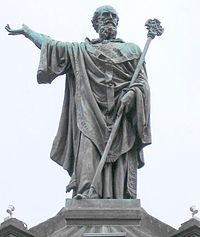
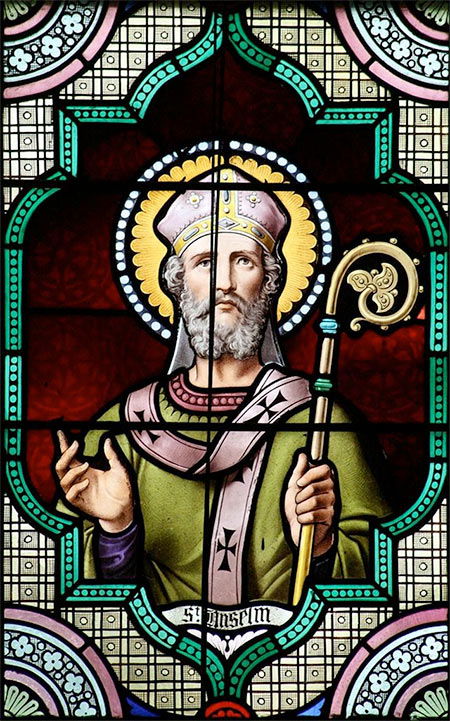
| Saint Anselm from History Today |
Anselm was a Benedictine monk, who rose to become the influential Archbishop of Canterbury. His ontological proof for the existence of God is still studied by philosophers and Christian apologists. He stands as one of the most important thinkers of the medieval period and his theological work Cur Deus Homo or Why God Became Man still impacts both Roman Catholic and Protestant theology.
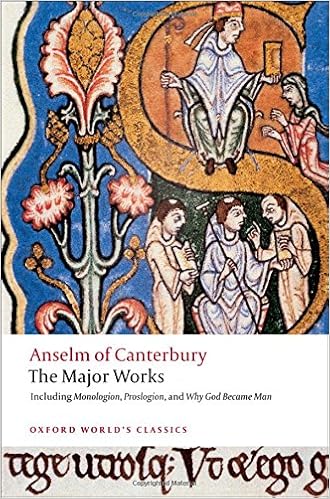 |
| Anselm of Canterbury: The Major Works Oxford University Press |
At the center of Christian theology lies
the person of Jesus Christ. Jesus’ death and suffering upon the cross remain the act which most Christians look upon
as central to their salvation. From the beginning of the Christian Church,
theologians debated the meaning of the death of Jesus upon the cross. Today,
most Catholics and Protestants hold to some form of vicarious atonement, teaching
that the death and suffering of Jesus upon the cross satisfied the Holiness and
Justice of God. The growth and widespread acceptance of plenary atonement
largely rest on the teaching of Anselm of
Canterbury in his work, Cur Deus Homo (Why God Became Man). The influence of
Anselm in framing this central doctrine of faith and his work merits an investigation into the formulation what
Christians believe about the Cross of Christ. This paper will explore Anselm
and his ideas of atonement through Cur Deus Homo and the impact upon the
Church.
Anselm was born
in 1033 in the town of Aosta within the Piedmont region of Italy. Knowledge
regarding the life of Anselm comes from a variety of sources including his
works and that of his close associate Eadmer. Eadmer first met Anselm briefly about
1079, and then thirteen years later he became the constant companion and
biographer of Anselm.[1]
Eadmer possessed great skill as a biographer and his intimate relationship, and
careful listening allows the reader to grasp an understanding of the concerns
and personality of Anselm.[2]
Eadmer’s account of Anselm’s final years remains
absent since Anslem ordered Eadmer to destroy the writings. Eadmer obeyed but
not before making a copy of his work.[3]
Much of the knowledge regarding Anselm’s later life comes from his sermons and
letters.
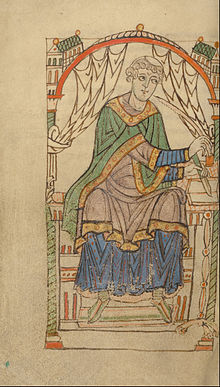 |
| Eadmer from Wikipedia |
Anselm left his
Italian home in 1056 from what appears to be a contentious relationship with
his father. As a child, Anselm had a devoted relationship with his mother, but
her early death left him with a father with whom he had little in common.[4]
He crossed the Alps and at the age of twenty-six became a Benedictine monk at
the abbey of Bec in Normandy. Anselm found himself drawn to Bec largely because
of the reputation of one of the priors of Bec, Lafranc.[5]
He became Lafranc’s pupil and eventually
succeeded his master in the office of prior and then abbot. In 1093, Anselm
followed Lafranc as the Archbishop of Canterbury, an office he held until his death in 1109. Anselm was a reluctant
archbishop since his first love was study and reflection and he feared that the
duties of office meant time away from his study. He often found his administrative
duties onerous and longed for a solitary life of research and reflection, but
his superiors ignored his pleas and continued to place him in pastoral and
supervisory roles.[6] Eadmer summarizes Anselm’s devotion to study,
For he had so much faith in the Holy Scriptures, that he firmly and
inviolably believed that there was nothing in them which deviated in any way
from the path of solid truth. Hence he applied his whole mid to that end, that
according to his faith he might be found worthy to see with the eye of reason these things in the Holy Scriptures
which, as he felt, lay hidden in a deep
obscurity.[7]
Upon accession as the archbishop of Canterbury,
Anselm found himself in conflict with the monarchs of England. First with
William Rufus and then with Henry I over the question of investiture and the
relationship of the church and state in England.[8]
Conflict with the monarchy sent Anselm into two exiles but reconciliation brought
him back to Canterbury, and he remained in office until his death in 1109.
Anselm was an active writer and wrote Cur Deus Homo while archbishop. Through
his writings, Anselm became one of the most important intellectuals of medieval
Europe and still impacts both contemporary Catholic and Protestant theology.
Anselm is
considered by many as the Father of scholasticism. Like the majority of
medieval theologians, Anselm fell under the influence of Augustine. The extent
of Augustine’s influence is difficult to determine but Anselm was never content
with a repetition of the Augustine. Anselm’s language rose from the theology of
Augustine, but his ideas and direction are his own.[9]
Anselm saw no separation between faith and reason, but believed that there was
an indispensable unity between both. He held that this gave the theologian the
freedom to explore dogma using the “instruments of grammar and logic.[10]
Anselm believed that reason aided the Christian in a fuller understanding of
the faith and theology and revealed the inner consistency and rationality of
Christian faith.[11] The use of reason alone
verifies the logic of faith and Scripture, therefore the theologian can
deliberate on the nature of God without Scripture. Most of Anselm’s writings
contain little exegesis since he believed that he could reach truth through the
use of reason and logic.
Certain brethren have often and earnestly entreated me to put in
writing some thoughts that I had offered them in familiar conversation,
regarding meditation on the Being of God, and on
some other topics connected with this subject, under the form of a meditation
on these themes. It is in accordance with their
wish, rather than with my ability, that they have prescribed such a form for
the writing of this meditation; in order that nothing in Scripture should be
urged on the authority of Scripture itself, but that whatever the conclusion of
independent investigation should declare to be true, should, in an unadorned
style, with common proofs and with a simple argument, be briefly enforced by
the cogency of reason, and plainly expounded in the light of truth. It
was their wish also, that I should not disdain
to meet such simple and almost foolish objections as occur to me.[12]
The importance
of reason for Anselm cannot be understated and places him first among a long
list of medieval scholastics. He believed that logic was an essential tool for
the theologian but he did not drive a wedge between logic and faith. Reason
does not supplant faith but reason places one on the path towards true faith. A
conclusion might appear sound but if it contradicts the teaching of Scripture
then this is a sign that one needs to rethink the soundness of the argument.
Humanity cannot comprehend the full mystery of the Godhead but God is rational
and any communication from God is coherent and without contradiction. Since
Scripture is the primary source of revelation then it contains no contradiction
with reason.[13] Reason is at the forefront of Anselm’s classic works the Monologion
and the Proslogion. Within the Monologion Anselm sought to
explore the divine attributes of God and his existence through the use of
reason. Anselm claims that since there are many signs and kinds of good then
there must be a supreme good through which all unite. Because one can discern different levels of goodness leads
to the conclusion that there exists absolute goodness. Therefore, Anselm
reasons that there is one “being greater
and higher than all others through whom they all exist.[14]”
In the Proslogion, Anselm argues for his ontological proof for God’s
existence in which he claims that God is that, “whom nothing greater can be thought.[15]
Because God is a being which nothing greater can be thought then he must exist not only in one’s mind but also in
reality.[16] The ontological argument
of Anselm remains a key argument within apologetic debates regarding proofs of
the existence for God. The original title of the Proslogion, Fides quaerens intellectum
or Faith seeking understanding point to the importance of reason for Anselm.
The correct use of reason points to God, therefore Anselm attempts to
understand a faith he already believes.
Anselm’s
theological masterpiece remains Cur Deus Homo. and like the theologians
of the ancient church. Anslem strives to understand why God lowered himself by
becoming a man and subjecting himself to the humiliating death upon the cross.
Most theologians of the early church debated the nature of God and the humanity
and divinity of Christ. The work of the atonement and soteriology was not a debate during this period. The idea of
atonement is central to understanding Anselm and other theologians who grapple
with the meaning of the cross of Christ. Atonement entails the proposition that
sinful humanity needs redemption from sin and that the cross is a means of
salvation. When exploring the question of the atonement one must ask how Christ
through the cross brings reconciliation
between God and humanity. The meaning and
work of Christ upon the cross continues to stem debate and theological
discussion among the Christian world. Ancient
theologians proposed a number of theories
many often appearing contradictory with some ideas being held by the same theologian.[17]
Early Christians understood that Christ brought salvation but few asked the
question how Christ saved. Theologians who allowed no compromise regarding
”trinitarian and Christological orthodoxy were quite willing to manipulate
soteriological theories and images
without similar compunction.[18]”
Irenaeus connected
the incarnation to salvation by proclaiming that Jesus’s incarnation provided
redemption. He believed that “human nature was sanctified, transformed, and
elevated by the very act of Christ’s becoming a man.”[19]
Jesus’ very appearance as a man demonstrated Christ’s ability to save fallen
humanity. Irenaeus’ emphasis on the Incarnation was a response to what he
viewed as Gnostic heresy which deemphasized the importance of the Incarnation.
The divine Son of God became the Son of Man to accomplish redemption.
But God the Father was very merciful: He sent His creative Word, who in coming to deliver us came to the very place
and spot in which we had lost life, and
brake the bonds of our fetters. And His light appeared and made the darkness of
the prison disappear, and hallowed our birth and destroyed death, loosing those same fetters in which we were enchained. And He manifested |the
resurrection, Himself becoming the first-begotten of the dead, and in Himself
raising up man that was fallen, lifting
him up far above the heaven to the right
hand of the glory of the Father.[20]
Irenaeus’ viewed that the relationship lost through
the first man became renewable through Christ. Irenaeus used the term
recapitulation to describe that humanity “fell in our solidarity with the first
man, we can be restored through our
solidarity with Christ.”[21]
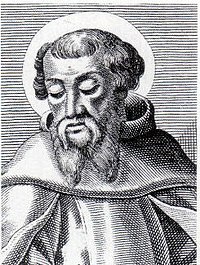 |
| Irenaeus from Wikipedia |
Many ancient
theologians held to a theory often called the Ransom Theory. They maintained that
humanity belonged to Satan and that God offered Jesus as a ransom or sacrifice
for sinners. The devil looking at the
agreement as a bargain because he viewed Christ as a far greater prize. But
once Christ arrived in hell, Satan lacked the power to hold him, and Christ
entered into mortal combat for the salvation of humanity. While the crucifixion
appeared as a defeat, Christ resurrected
in triumph and broke the power of the enemy and his victory made immortality
possible for believers.[22]
They believed that in the ransom, Christ defeated the forces of evil. Irenaeus,
Origen, and Gregory of Nyssa taught versions of this theory. Origen is very explicit in his use of the word
ransom and insists that the ransom which
Christ paid was meant not for God but for
the Devil.[23] Gregory of Nyssa expounds on the ransom in Chapter 23 of the Catechetical Oration,
The Enemy, therefore, beholding in Him such power, saw also in Him an
opportunity for an advance, in the exchange, upon the value of what he held. For this reason he chooses Him as a ransom for
those who were shut up in the prison of death. But it was out of his power to
look on the unclouded aspect of God; he must see in Him some portion of that fleshly
nature which through sin he had so long held in bondage…His choosing to save
man is a testimony of his goodness; His making the redemption of the captive a
matter of exchange exhibits His justice, while the invention whereby He
enabled the Enemy to apprehend that of which he was before incapable, is a
manifestation of supreme wisdom.[24]
Athanasius holds to a doctrine of atonement
similar to other ancient fathers with some distinctions.
He held that by physically becoming a man,
Christ repaired the image of God humanity lost due to the corruption of sin.
We have seen that to change the corruptible to
incorruption was proper to none other than the Savior Himself, Who in the
beginning made all things out of nothing; that only the Image of the Father could
re-create the likeness of the Image in men, that none save our Lord Jesus
Christ could give to mortals immortality, and that only the Word Who orders all
things and is alone the Father's true and sole-begotten Son could teach men
about Him and abolish the worship of idols.[25]
The restoration of the image of God within man
allows all men to recover the true knowledge of God and then enjoy full
fellowship with God.[26]
Athanasius’ major concern was the battle against Arian heresy, the nature of the atonement and redemption was not
his primary concern. Like other ancient theologians, he felt the urgency to
defend Nicean Christianity against Arianism which limited the full divinity of
Christ.
 |
| Athanasius from Wikipedia |
Augustine
also stresses the Incarnation of Christ as the instrument of man’s salvation
and stresses Christ’s role as mediator between God and humanity. The image of
God in man remains but it has been greatly damaged. Augustine pictures Christ
as the physician who brings healing through the love and grace of God.[27]
Augustine also makes reference to mankind
trapped in the bondage of Satan and the need of the redemption of Christ to
release sinners. Augustine recognizes no proprietary rights of the devil over
humanity, but he still describes humanity “delivered into the power of the
devil.”[28].
He sees the passion and the Resurrection as Christ’s victory over Satan and
through the mediation of Jesus, the Devil lays defeated by the righteousness of
Christ.[29]
Augustine emphasizes the righteousness of Christ saying,
But the devil was to be overcome, not by the power of God, but by His righteousness. For what is more powerful than the
Omnipotent? Or what creature is there of which the power can be compared to the power of the Creator?[30]
While different than earlier Church Fathers,
Augustine still bears similarity to the Ransom Theory held by Origen and
Gregory of Nyssa nonetheless Augustine emphasizes how sin allows Satan a hold
on the life of the believer but that hold loses power through the sacrifice
offered by Christ in His passion.[31]
While
Anselm’s apologetic works appear primarily as works of philosophy, Cur Deus
Homo is chiefly a work of theology. Nevertheless, Anselm utilizes the same
philosophical method of reason in his examination
of the Atonement. Anselm explains in his preface that his goal is to explain with
reason the skeptic’s objections to the
Christians faith and by “equally clear reasoning and truth that God created
humanity to enjoy eternal life.[32]
But to demonstrate this to the unbeliever, Anselm recognizes the need to show
that mankind needed the intervention of a
“Man-God” to deliver salvation.[33]
Anselm
began the writing of Cur Deus Homo
between 1095 and 1098 and completed it during his exile in Capua. Eadmer
describes Anselm’s period in Capua as a period of study and reflection similar
to his early life before he became an abbot. Eadmer credit’s prayerful
reflection and love of God as giving Anselm the motivation for writing the
book.[34]
Most of Cur Deus Homo takes the form of a dialogue between Anselm and
Boso, one of his monks from Bec. Boso serves the function of a advocatus diaboli
or devil’s advocate and brings challenges to Christian doctrine which Anselm
seeks to respond.[35]
It’s possible that much of his motivation for writing
rose from concerns over the
questions posed by Jews and Muslims. During 1092, questions arose regarding the
incarnation from questions raised by some learned Jews in London[36]
and during his exile in Capua, Anselm had some
positive encounters with Arabs during the siege of Capua.[37]
His apologetic concerns perhaps lay behind his
motive for writing Cur Deus Homo.
The
first question Anselm answers is the necessity of the Incarnation. Because God
is omnipotent then one might conclude that He could redeem man through an angel or another person or just through his
command. According to Anselm, God’s actions are not due to any external
compulsion or inability. The Incarnation of Christ is not a decision God makes
because of any outside force but is a result of God’s nature and completely
free choice.[38] Anslem wishes to answer
the objection that the Incarnation demeans God by lowering Him as a suffering
human. Anselm argues that the incarnation is vital for the redemption of mankind.[39]
Because Adam fell into sin, Anselm explains that only a sinless God-man could
bring the necessary satisfaction for the sin of humanity.
For it was appropriate that, just as death entered the human race
through a man’s disobedience, so life should be
restored through a man’s obedience; and that, just as the sin which was
the cause of our damnation originated from a woman, similarly the originator of
our justification and salvation should be born of woman.[40]
Anselm deals with the confusion that many
unbelievers have about the Incarnation declaring that they lack an
understanding of Christianity.
People who say this do not understand what we believe. For we affirm
that the divine nature is undoubtedly
incapable of suffering, and cannot in any sense be brought low from its exalted
standing, and cannot labour with
difficulty over what it wishes to do. But
we say that the Lord Jesus Christ is true God and true man, one person in two
natures in one person. In view of this,
when we say that God is suffering some humiliation or weakness, we do not
understand this in terms of the weakness
of the human substance which he was taking upon himself… For we are not, in
this way, implying lowliness on the part on the part of the divine substance,
but are making plain the existence of a single person comprising God and man.[41]
Anselm
regards the dilemma of humanity to be a problem of a broken relationship. He
regards sin as a debt owed to God whose nature demands satisfaction from a holy
and righteous God. In Adam, all humanity fell into a sinful condition. Sin placed mankind
into a predicament that they could not solve for themselves. Anselm contended that humanity owed a debt to God not
to Satan because God’s honor and righteousness remain
dishonored. Sin is to take from God the worship and adoration due to him alone.
Anselm describes the debt,
This is the debt which an
angel, and likewise a man, owes to God. No one sins through paying it, and
everyone who does not pay it, sins. This
is righteousness or uprightness of the will. It makes individuals righteous or
upright in their heart, that is, their will. This
is the sole honour, the complete honour, which we owe to God and which God
demands from us… Therefore, everyone who sins is under an obligation to repay
to God the honour which he has violently
taken from him, and this is the satisfaction which every sinner is obliged to
give to God.[42]
Anselm believes that forgiveness without atonement and
satisfaction is impossible because forgiveness without satisfaction offends the
nature of God. Sin must receive punishment as the holiness of God demands
justice for the debt of sin. Anselm insists that,
it is not fitting for God to
forgive a sin without punishment…. If a sin is
forgiven without punishment: that the position of sinner and non-sinner
before God will be similar-and this does not befit
God.[43]
Anselm stresses the
justice of God, which demands satisfaction and cannot forgive by mere fiat
since forgiveness without the payment of debt is a violation of the “order in
the universe that God had to uphold to be consistent with himself and with his
justice.”[44]
Anselm refutes the ransom theory, held by so many
theologians of the ancient church. He states that God cannot simply
“raise anyone who is to any extent bound by indebtedness arising from sin.” [45]
The one who claims that God can simply
overlook or proclaim sin forgiven without satisfaction underestimate the great
burden of sin. Anselm admits that Satan possesses
power over sinful humanity but the debt of man remains a debt owed to God not
Satan. Sinners who allow themselves captivated
by Satan offend God. If the payment of sin belonged to Satan, then Anselm
maintains that the need of the Incarnation was unnecessary. The problem with
the ransom theory is that it fails to account for the necessity of the Incarnation and the need for the sacrifice of Christ to
obtain forgiveness.
The
ransom theory also fails the test of justice. The ransom theory claims that
Satan possessed rights over sinful humanity and God must respect those rights.
The life and death of Christ was an opportunity for God to play on the devil’s
greed by giving him a deal he could neither reject or win because of the power
of Christ. Losing the bet caused Satan to lose his sovereignty over mankind.
Anselm rejects this picture of justice.
For, supposing that the devil, or man, were his own
master, or belonged to someone other than God, then perhaps one could justly
speak in those terms. However, given that neither the devil nor man belongs to
anyone but God, and that neither stands outside God’s power.[46]
The ransom theory fails the test
of justice because the devil has no dominion over humanity, for he is subject
to the judgment and sovereignty of God. Satan, like humanity, is a creature
subject to the God’s sovereign rule. And redemption is solely under God’s
providential will. If Satan has any involvement on the suffering of humanity
then it is not a decision of the devil but the judgment of God who uses even
evil things to accomplish his purposes.[47]
Once establishing the impasse which sin causes for humanity, Anselm turns
to the solution offered by Christ in Book II. Anselm asserts that salvation
depends upon payment for the debt of sin,
[48]If, therefore, as is agreed, it is necessary that the
heavenly city should have its full complement made up of members of the human
race, and this cannot be the case if the recompense of which we have spoken is
not paid, which no one can pay except God, and no one ought to pay except man;
it is necessary that a God-Man should pay it.[49]
God remains determined to redeem
the human race from the consequences of their sin. Humanity remains the
pinnacle of His creation and His intervention is vital to the preservation of
the human race. God’s purpose is the completion and perfection of His creation.[50]
Because sin came into the world through the first human then justice required
recompense from a human. But no one has the ability to stand guiltless before
the justice of God because all remain tainted by sin. Only Jesus fit the needed
requirements of justice since Jesus Christ is fully man and God. Anselm affirms
the creed laid out by the Council of Chalcedon by affirming that Christ is one person
with both human and divine natures. Anselm concludes that salvation is
“necessary for divine and human nature to combine in one person.”[51]
The justice of God receives
satisfaction from the death of Christ which “outweighs the number and magnitude
of all sins.” [52]
Even small sins are of “such infinite magnitude” that they offend the holiness
and justice of God. Christ’s atonement is so potent that His death redeems the
sins of those who put him to death.[53] According to Anselm, logic dictates that the
Heavenly city have citizens from the human race which is impossible unless
sinners receive forgiveness and remission of sins. Remission of sins only
comes,
through a man
who is identical with God and who by his death reconciles sinners to God. We
have already found Christ, whom we acknowledge to be God and man and to have
died for our sakes.[54]
Boso
admits that Christ freely gave his life as a gift to pay recompense for the
sins of man but asks how his death pays for sin and the difference between the
death of Christ and those of John the Baptist and other martyrs. Anselm explains the uniqueness of Christ’s death
because Christ alone paid a “debt which he did not owe.”[55]
Christ paid a debt which sinners were unable to pay and his willingness to lay
his life revealed an act of undeserving grace. Christ was under no obligation
to save humanity, it was his “prerogative to suffer or not to suffer.” Jesus’
death was not the result of a debt to the Father or humanity rather he died
because of a free desire to save mankind. Christ was free not to die but his
willingness to die renders his sacrifice all the more magnificent.[56]
Because Christ freely and willingly gave his life then Anselm reasons
that the Son deserves recompense for his sacrifice. The reward owed to Jesus is
a gift the Son gives to those lack any ability to pay their debt. The salvation
of the human race is the first fruits and reward for those He died upon the
cross. On whom id it more appropriate for him to bestow the reward and recompense for his death than on
those whose salvation, as the logic of truth teaches us, he made himself a man,
and for whom, as we have said, he set an example, by his death, of dying for the
sake of righteousness? For they will be imitators
of him in vain, if they are not sharers in his reward.[57]
Anselm makes it clear that the debt of sin was owed
to God. There was no need inherent within God that required the death of Christ
rather it was a sacrifice freely given. Anselm clearly refutes the ransom
theology held by the early church. Mankind did not owe the devil a debt for
humanity’s sin offended God.
Certainly God did not owe the devil anything but punishment, nor did
man owe him anything but retribution-to defeat in return him by whom he had
been defeated. But, whatever was demanded from man, his debt was to God, not to
the devil.[58]
The
atonement of Christ reveals both the mercy and justice of God. The great sin of
humanity and the demands of God’s justice appear insurmountable when first
observed but God’s mercy appears through the self-sacrifice of the Son of God
who freely offered himself up for the sinful debt humanity accumulated. Redemption
occurs because the atonement of Christ offers sufficient satisfaction for the debt of sin owed by the human race.
If
sin is forgiven without punishment or satisfaction then the forgiveness is
cheap and without meaning. This places sinful humanity and sinless humanity in
the same standing. The holiness and justice of God demands punishment and the
state of sin remains. Injustice stands above the law and holiness with
unpunished sin.[59] Justice demands
punishment but Anselm recognizes that the intervention of God through the
passion of Christ demonstrates the mercy of God. The death of Christ is
sufficient for any sin and nothing could be more merciful than the sacrifice of
the Son upon the cross.[60]
Some
scholars maintain that the roots of Anselm’s atonement theology lay in the practice of German law
and that the idea that sin must receive either punishment or satisfaction was a
new idea imported from feudal law practices.[61]
But earlier Latin theologians discussed satisfaction in the context of penance
as a way satisfying the Lord. Penance appeared
to overlap but failed because, “
even in rendering such satisfaction, man was giving God only what he
owed him. But the satisfaction offered by the death of Christ possessed
infinite worth, and this the redemption on the cross could be seen as the one supreme
act of penitential satisfaction.[62]
One
of the earliest critics of Anselm’s doctrines was the theologian Peter Abelard,
whose most active years as a theologian and philosopher followed the death of
Anselm. Abelard appears as the foremost opponent Anselm’s doctrine of the
atonement and the principal proponent of the exemplarist
or moral example theory.[63]
Abelard’s moral influence theory is a subjective theory of the atonement
because it emphasizes how the moral example of the cross brings change in people.[64]
Abelard also rejected the ransom theory of the atonement and asserted that the
devil had no rights over humanity but he also rejected the proposal that the
death of Christ brought satisfaction for sin.
How very cruel and unjust it seems that someone should require the
blood of an innocent person as a ransom, or that in any way it might please him
that an innocent person be slain, still less that God should have so accepted
the death of his Son that through it he was reconciled to the whole world. These and similar things seem to
us to inspire a not insignificant question, namely, concerning our redemption
and justification through the death of our Lord Jesus Christ.[65]
Abelard rejected the idea that the death
of Christ satisfied the honor and justice of God rather the cross was the
ultimate display of God’s love. The importance of the atonement was the
impact the love of God had upon the hearts of
humanity.
Nevertheless it
seems to us that in this we are justified in the blood of Christ and reconciled
to God, that it was through this matchless grace shown to us that his Son
received our nature, and in that nature, teaching us both by word and by
example, persevered to the death and bound us to himself even more through
love, so that when we have been kindled by so great a benefit of divine grace,
true charity might fear to endure nothing
for his sake…Therefore, our redemption is that supreme love in us through the
Passion of Christ, which not only frees us from slavery to sin, but gains for
us the true liberty of the sons of God.[66]
Abelard
asserts that salvation is the declaration of God’s love demonstrated in the
life and death of Jesus. The purpose of the atonement was to restore the love
of God into the hearts of humanity through the self-sacrificial
example of Christ. The was no need of reconciliation from God since he offered
forgiveness but man needs to turn his heart toward the forgiveness offered by
God. The purpose of the life and death of Jesus was to demonstrate the love of
God to a distant humanity.[67] By faith, the Christian ascesses the transforming power of God
exhibited by the example of Jesus.[68] Abelard presented his
views in a short passage in his Commentary on the Epistle to the Romans and was
not a full account of his beliefs on the atonement.[69]
Abelard’s brief explanation of the
moral influence theory of the atonement finds renewed interest in contemporary
theology which decry the picture of an angry and wrathful God, who demands
justice. The moral example of Jesus and his sacrificial forgiveness
demonstrated in his passion serves as a moral exemplar and incentive for a
changed life. Anselm anticipates this criticism when Boso questions Anselm
regarding the mercy of God. Anselm exhibits that God’s mercy cannot conflict
with His law or the moral ordering of the universe.[70] Any consideration of
God’s mercy and kindness must account also for God’s judgment. While Boso maintains that complete forgiveness appears consistent with a God of mercy, Anselm
counters that forgiveness is not just, if justice remains forgotten.[71] God himself is both mercy
and justice and any doctrine which neglects both falls short according to the
logic presented by Anselm. God can neither abandon his creation nor can he
leave the debt of sin unpunished.
The debate between Anselm and
Abelard continues to frame the debate over the nature of the Atonement in
Christian theology. Anselm’s argument that the death of Christ satisfies the
justice of God remains the primary orthodox position within the Roman Catholic Church[72] and most Protestant
Churches. The doctrine of the plenary substitutionary atonement held by many
Protestants bears great similarity and dependency upon Anselm’s explanation of
the death of Christ. Christ’s death is penal because he paid the judicial and
legal price for sin and it is substitutionary
because Christ was the substitute for sinners who deserved punishment. While
Anselm never spoke of a substitution the concept is similar to Christ
satisfying the justice of God. The influential Westminster Confession of Faith
summarizes the principle of substitution held by most Protestants,
Christ, by His
obedience and death, did fully discharge the debt of all those that are thus
justified, and did make a proper, real, and full satisfaction to His Father's
justice in their behalf. Yet, inasmuch as He was given by the Father for them, and His obedience and satisfaction accepted in
their stead, and both, freely, not for anything in them, their justification is
only of free grace; that both the exact justice and rich grace of God might be
glorified in the justification of sinners.[73]
The
language of debt and justice is very similar to the words used by Anselm and
while the Westminster divines sought to justify their doctrine with Scripture
the progression of their doctrine of atonement clearly derives from the
doctrines first presented by Anselm.
Recent years interest in the ransom
theory has grown since the publication of ChristusVictor by Gustaf Aulen. While Aulen
rejects the idea of a ransom paid to Satan he proposes that the central purpose
of the atonement is the defeat of sin and the forces of evil to free humanity
from their captivity and oppression. Aulen
criticizes Anselm for holding to a view of that world which is at its heart
legal.
In this scheme Law is represented as the
granite foundation of the spiritual world. To the classic idea, on the other
hand, it is essential that the work of atonement which God accomplishes in
Christ reflects a Divine order which is wholly different from a legal order;
the Atonement is not accomplished by strict fulfillment the demands of justice,
but in spite of them. God is not, indeed,
unrighteous, but He transcends the order of justice.[74]
Aulen maintains
that the Latin viewpoint of Anselm derives from the legalistic character of the
medieval worldview. He maintains that theologians of the Reformation then
accepted Anselm without questioning the legalism which lay beneath the
doctrine.[75]
Aulen further rejects the subjective view of Abelard and many contemporary
theologians as still captive to individualism and rationalism. While liberal
Protestantism opposes the Scholasticism, Aulen
claims that the moral influence view of the atonement remains, “penetrated from
end to end by an idealistic philosophy, and seeks to interpret the Christian
faith in the light of a monistic and evolutionary worldview.”[76]
According to Aulen, the Christus Victor
is the classical view of the atonement since variations of the view dominated
Christian doctrine for most of church history. The atonement is a victory over
sin death, and the devil. Sin is an objective power holding power over humanity
which the death and resurrection of Christ defeats. Salvation is the fruit of
the triumph of Jesus over evil.
The victory of
Christ over the powers of evil is an eternal victory, therefore present as well
as past. Therefore Justification and Atonement are really one and the same
thing; Justification is simply the Atonement brought into the present, so that
here and now the Blessing of God prevails over the Curse.[77]
Aulen’s ideas continue to cause ripples
within theological circles and his points have reframed the deliberations over
atonement from a two-sided dispute into a three-sided
debate. Opponents of Aulen point to the fact that “Anselm views Christ’s
satisfying death within a larger framework of Christ’s entire saving work as
restoring human nature.”[78] Under Anselm human nature receives exaltation and
glory as the special creation of God.
Christ exalts human nature through the
Incarnation and restores the relationship between God and man through the work
on the cross repairing and bring humanity into an exalted position. Aulen accuses Anselm of divorcing Incarnation
and Atonement but as seen earlier Anselm roots his doctrine of Atonement in
Chalcedonian doctrine and views the Incarnation and Atonement as an organic
whole.[79]
The cross remains at the of Christianity
and the debates over the purpose and meaning behind the death of Christ
continue to rage within Christian circles since the beginnings of the early
church. The cross occupies both theological and artistic disputes within the
Christian and Western world. Anselm still looms large in any examination of the
atonement. While Scripture remains the tool used by most theologians, Anselm's use of reason and logic sets an
apologetic example of early Scholasticism. No theological or historical
examination of the impact of atonement is complete without a consideration of
Anselm’s Cur Deus Homo.
Bibliography
Abelard, Peter. Commentary on the
Epistle to the Romans. Translated by Steven R. Cartwright. Washington: The
Catholic University of America Press, 2011.
Anselm. Anselm of Canterbury: The
Major Works. Oxford: Oxford University Press, 2008.
Anselm, Monologium, On the Being
of God, Translated by Sidney Norton Deane, 1903, from http://www.sacred-texts.com/chr/ans/ans033.htm
Athanasius, On the Incarnation of
the Word, Christian Classics Ethereal Library, https://www.ccel.org/ccel/athanasius/incarnation.v.html
Augustine. On the Holy Trinity.
New Advent. http://www.newadvent.org/fathers/130113.htm
Aulen, Gustaf. Christus Victor: An
Historical Study of the Three Main Types of the Idea of Atonement, translated
by A.G. Hebert, Austin: Wise Path Books, 2003.
Baldwin, Joseph W. The Scholastic
Culture of the Middle Ages, 1000-1300. Prospect Heights, Illinois: Waveland
Press, 1971.
Bysted, Ane L. The Crusade
Indulgences: Spiritual Rewards and the
Theology of the Crusades, c. 1095-1216. Leiden: Brill, 2015.
Davies, Brian and Brian Leftow, editors. The Cambridge Companion to Anselm. Cambridge: Cambridge University
Press, 2004.
Eadmer, The Life of St. Anselm: Archbishop of Canterbury, Translated
by R.W. Southern. , edited by R.W. Southern, Oxford, Clarendon Press, 1962.
Fairweather, Eugene R, A Scholastic Miscellany: Anselm to Ockham, New York: The Macmillan Company, 1970.
Grane, Leif. , Peter Abelard, Translated
by Frederick and Christine Crowley.New York: Harcourt, Brace and World,
Inc.1964.
Gregory of Nyssa. Catechetical
Oration, Christian Classics Ethereal Library,
https://www.ccel.org/ccel/schaff/npnf205.xi.ii.xxv.html
Hauser, Alan J. and Duane F. Watson, editors. A History of Biblical Interpretation, Vol. 2: The Medieval through the
Reformation Periods. Grand Rapids, MI: Wm. B. Eerdmans Publishing Co.,
2009.
Hopkins, Jasper. A Companion to
the Study of St. Anselm. Minneapolis: University of Minnesota Press, 1972
Irenaeus. The Proof of the
Apostolic Preaching, The Tertullian Project,
http://www.tertullian.org/fathers/irenaeus_02_proof.htm
Kelly, J.N.D. Early Christian
Doctrines, New York: Harper and Row Publishers, 1960.
Komonchak, Joseph A. “Redemptive Justice: An Interpretation of the Cur
Deus Homo,” The Dunwoodie Review,
12(1972) 33-55.
Lane, Tony. A Concise History of
Christian Thought. Grand Rapids, Michigan: Baker Academic, 2006.
Leftow, Brian. "Anselm on the Necessity of the Incarnation." Religious
Studies 31, no. 2 (June 1995): 167-85.
McBrian, Richard P. Catholicism.
Minneapolis: Winston Press, 1980.
McGiffert, Arthur Cushman. A
History of Christian Thought, Volume II: The West From Tertullian to Erasmus,
New York: Charles Scribner’s Sons, 1933.
McIntyre, John. St. Anselm and His
Critics: A Re-Interpretation of the Cur Deus Homo, Edinburgh: Oliver and
Boyd, 1954.
Ortland, Gavin. “On the Throwing of Rocks: An Objection to Hasty and
Un-careful Criticisms of Anselm’s Doctrine of the Atonement,” The Saint Anselm Journal, 8 no.2 (Spring
2013), 1-17.
Pelikan, Jaroslav. The Emergence of the Catholic Tradition (100-600).
Chicago: The University of Chicago Press, 1978.
Pelikan, Jaroslav. The Growth of Medieval Theology (600-1300).
Chicago: The University of Chicago Press, 1978.
Pelikan, Jaroslav. The Melody of
Theology: A Philosophical Dictionary. Cambridge: Harvard University Press,
1988.
Radford, Rosemary, Carter Heyward, and Mark L. Taylor. Contemporary Christologies: A Fortress
Introduction, Minneapolis: Augsburg Fortress Publishers, 2010.
Southern, R.W. Saint Anselm A Portrait in a Landscape. Cambridge:
Cambridge University Press, 1990.
Southern, R.W. Saint Anselm and
His Biographer. Cambridge: Cambridge University Press, 1966.
Welch, A.C. Anselm and His Work. New York: Charles
Scribner's Sons, 1901.
Westminster
Confession of Faith, Presbyterian
Church in America, http://www.pcaac.org/resources/wcf/
[5] R.W. Southern, Saint Anselm and His Biographer. (Cambridge: Cambridge University
Press, 1966), 12.
[6] E.W. Evans, “Anselm’s life, works,
and immediate influence.” In The Cambridge Companion to Anselm. Eds. Brian Davies and Brian
Leftow (Cambridge: Cambridge University Press), 10.
[8] Arthur Cushman McGiffert, A History of Christian Thought, Volume II:
The West From Tertullian to Erasmus, (New York: Charles Scribner’s Sons,
1933), 185.
[9] Southern, Saint Anselm and His Biographer, 32.
[12] Anselm, Monologium, On the Being of God, tr. Sidney Norton Deane, 1903, from
http://www.sacred-texts.com/chr/ans/ans033.htm
[13] Jasper Hopkins, A Companion to the Study of St.
Anselm, (Minneapolis: University of
Minnesota Press, 1972),
44-45.
[14] McGiffert, 185.
[15] Anselm, Proslogion in A Scholastic Miscellany: Anselm to Ockham,
ed Eugene R. Fairweather, (Philadelphia: The Westminster Press, 1956), 75.
[16] Brian Davies, “ Anselm and the
Ontological Argument.” In The Cambridge Companion to Anselm. Eds. Brian Davies and Brian
Leftow (Cambridge: Cambridge University Press), 158-159.
[17] J.N.D. Kelly, Early Christian
Doctrines, (New York: Harper and Row Publishers, 1960), 375.
[18] Jaroslav Pelikan, The Emergence of the
Catholic Tradition (100-600), (Chicago: The University of Chicago
Press, 1971), 205.
[19] Ibid., 375.
[20]
Irenaeus, The Proof of the Apostolic
Preaching, The Tertullian Project,
http://www.tertullian.org/fathers/irenaeus_02_proof.htm
[22] Jaroslav Pelikan, The Melody of Theology: A Philosophical
Dictionary, (Cambridge: Harvard University Press, 1988), 12.
[23] Kelly, 185.
[24] Gregory of Nyssa, Catechetical
Oration, Christian Classics
Ethereal Library, https://www.ccel.org/ccel/schaff/npnf205.xi.ii.xxv.html
[25] Athanasius, On the Incarnation of the Word, Christian Classics Ethereal Library,
https://www.ccel.org/ccel/athanasius/incarnation.v.html
[26] Kelly, 378.
[27] Pelikan, The Emergence of the Catholic Tradition (100-600), 301-302.
[29] Kelly, Early Christian Doctrines,
391-392.
[30] Augustine, On The Holy Trinity, 13. 17, New Advent,
http://www.newadvent.org/fathers/130113.htm.
[31] Kelly, Early Christian Doctrines, 392.
[32] Anselm, Why God Became Man in A Scholastic Miscellany: Anselm to Ockham,
ed Eugene R. Fairweather, (Philadelphia: The Westminster Press, 1956), 100.
[33] Ibid., 100.
[34] Eadmer, The Life of St. Anselm, 107.
[37] Eadmer, The Life of St. Anselm, 111.
[38] Brian Leftow, “Anselm on the
Necessity of the Incarnation,” Religious
Studies 31, no. 2 (June 1995), 168.
[39] Jasper Hopkins, A Companion to the Study of St. Anselm, (Minneapolis: University of
Minnesota Press, 1972), 187.
[40] Anselm, The Major Works, Why God Became Man I.3, ed. Brian Davies and G.R.
Evans, trans. Janet Fairweather (Oxford: Oxford University Press, 1998),
268-269.
[44] Jarolslav
Pelikan, The Growth of Medieval Theology
(600-1300), (Chicago:
University of Chicago Press, 1978), 141.
[59] . Komonchak, “Redemptive Justice:
An Interpretation of the Cur Deus Homo,” The
Dunwoodie Review,52.
[61] McGifferet, A History of Christian Thought: Volume II: The West, From Tertullian to
Erasmus, 199.
[63] David Brown, Anselm on Atonement ” In The Cambridge Companion to Anselm. Eds.
Brian Davies and Brian Leftow (Cambridge: Cambridge University Press), 289.
[64] Rosemary Radford, Carter Heyward,
and Mark Lewis Taylor, Contemporary
Christologies: A Fortress Introduction, (Minneapolis: Augsburg Fortress
Publishers, 2010), 34.
[65] Peter Abelard, Commentary on the Epistle to the Romans,
Tran. Steven R. Cartwright,( Washington: The Catholic University of America
Press, 2011), 167.
[72] Richard P. McBrien, Catholicism,
(Minneapolis: Winston Press, 1980), 417-423.
[73] Westminster Confession of Faith 11.3, Presbyterian
Church in America, http://www.pcaac.org/resources/wcf/
[74] Gustaf Aulen, Christus Victor: An
Historical Study of the Three Main Types of the Idea of Atonement, tran. A.G. Hebert, (Austin: Wise Path
Books, 2003), 97.
[75] Aulen, Christus Victor: An Historical Study of the Three Main Types of the
Idea of Atonement, 99.
[76] Aulen, Christus Victor: An Historical Study of the Three Main Types of the
Idea of Atonement, 168.
[77] Aulen, Christus Victor: An Historical Study of the Three Main Types of the
Idea of Atonement, 160-161.
of Anselm’s Doctrine of the
Atonement,” The Saint Anselm Journal,
8 no.2 (Spring 2013),
4.
[79] Gavin Ortlund, “On the Throwing of
Rocks: An Objection to Hasty and Un-careful Criticisms of Anselm’s Doctrine of
the Atonement,” The Saint Anselm Journal,
6.